
Article
Simulating Artemis II: What a Free-Return Trajectory Actually Looks Like
Abstract
Artemis II will send astronauts around the Moon for the first time in over fifty years. I built a full trajectory simulation in NASA's GMAT to model the mission from parking orbit through lunar flyby and Earth return. Here's what the numbers look like and what they reveal about free-return trajectory design.
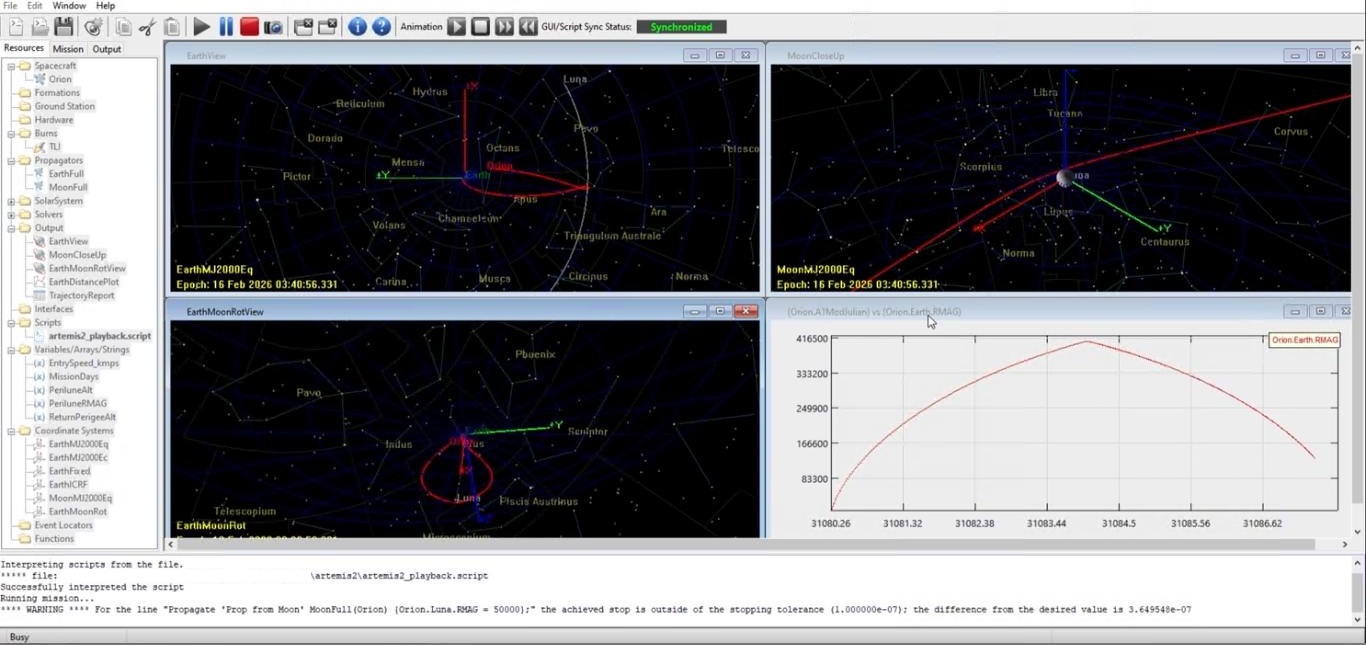
Artemis II will carry astronauts around the Moon for the first time since Apollo 17 in 1972. Before that happens, the trajectory has to work. "Work" means threading a very specific needle between the Earth and Moon at interplanetary speeds. I built a simulation of the Artemis II free-return trajectory using NASA's General Mission Analysis Tool (GMAT) to explore how the mission profile comes together and what the margins actually look like.
The Surprising Part
The differential corrector needs to adjust the parking orbit's right ascension (RAAN) and argument of perigee by tens of degrees from the initial guess to find a trajectory that threads a ~4,800 km lunar flyby and returns to Earth at exactly the right entry corridor. The converged RAAN lands at about 7 degrees, shifted over 20 degrees from the initial guess of 30. That sensitivity is why Artemis II launch windows are measured in hours, not days: the parking orbit geometry has to align precisely with the Moon's position at the time of departure.
Want the full simulation scripts and a detailed breakdown of the targeting approach? Get the Artemis II simulation package here.
What Was Modeled
The simulation covers the complete Artemis II mission profile from post-launch parking orbit through Earth re-entry interface:
- Parking orbit: 185 km circular, 28.5-degree inclination (standard KSC launch azimuth)
- Trans-lunar injection: Single impulsive burn of ~3.15 km/s
- Lunar flyby: ~4,800 km altitude pass over the lunar far side, no orbit insertion
- Free-return arc: Passive return to Earth with no mid-course corrections
- Entry interface: ~11 km/s at ~120 km altitude, targeting Pacific splashdown
- Total mission duration: ~8 days
The spacecraft is modeled as a 26,500 kg Orion vehicle. The TLI burn is impulsive (instantaneous delta-V), which is a standard simplification for trajectory design; the real ICPS burn duration would introduce small differences, but the trajectory geometry is representative.
Tools and Methods
The simulation was built entirely in NASA GMAT R2025a (General Mission Analysis Tool), an open-source flight dynamics platform used for real mission planning. Key technical choices:
- Propagator: Runge-Kutta 8/9 integrator with 1e-12 accuracy
- Earth gravity: JGM2 potential, 10x10 degree/order
- Lunar gravity: LP165P potential, 10x10 degree/order
- Third-body perturbations: Sun, Moon, Venus, Mars, Jupiter
- Solar radiation pressure: Spherical cannonball model, 1367 W/m² flux
- Targeting: Two-phase differential corrector: coarse targeting aligns the trajectory with the Moon's direction in the Earth-Moon rotating frame, then fine targeting constrains perilune altitude and return perigee
The two-phase targeting approach is worth noting. The first phase uses a simplified point-mass Earth model to quickly orient the departure trajectory toward the Moon by adjusting the parking orbit's RAAN and argument of perigee. The second phase switches to the full force model and adds the TLI delta-V as a free variable to simultaneously achieve the correct perilune distance (~6,537 km from lunar center) and free-return geometry (return perigee at ~6,438 km from Earth center). The solver converges in approximately 63 iterations.
Key Assumptions
A few simplifications are worth calling out:
- No ascent modeling: the simulation starts with Orion already in the parking orbit
- Impulsive burns: instantaneous velocity changes rather than finite-duration thrust arcs
- No propellant mass decrement: spacecraft mass stays constant throughout
- No atmospheric drag: negligible at 185 km over the ~1 hour parking orbit coast
- No mid-course corrections: the free-return trajectory is entirely passive after TLI
These are standard assumptions for preliminary trajectory design. A full mission-fidelity simulation would add finite burns, propellant bookkeeping, navigation errors, and correction maneuvers, but the trajectory geometry and delta-V budget are well-captured by this approach.
Note on launch dates: The scripts use a February 2026 epoch from an earlier planned launch window. The trajectory geometry and delta-V budget are representative regardless of the specific launch date; only the parking orbit orientation changes to align with the Moon's position at the time of departure.
I've packaged the complete GMAT scripts: targeting, playback, converged trajectory data, and full documentation. Get access to the simulation package.
What the Results Mean
The converged solution produces a trajectory that matches the publicly described Artemis II mission profile:
- TLI delta-V: 3.15 km/s
- Perilune altitude: ~4,800 km over the lunar far side
- Return entry speed: ~11 km/s
- Entry altitude: ~121 km
- Mission duration: ~7.6 days
The free-return constraint is the critical design driver. By targeting a specific perilune altitude and geometry, the trajectory naturally returns to Earth without any additional burns after the lunar flyby. This is the same class of trajectory used by Apollo 13: the abort-safe baseline that ensures the crew can return home even if the propulsion system fails after TLI.
The repo also includes the playback script with the converged solution baked in (RAAN = 7.029°, AOP = 86.598°, TLI = 3.1485 km/s) and a CSV trajectory report with state vectors at each mission milestone, useful if you want to visualize the trajectory in another tool or validate against your own propagator.
Why This Matters Beyond the Simulation
This type of trajectory modeling is core to what I do in consulting work at OrbitLink: building and validating simulations that answer real engineering questions before hardware flies. Whether it's a lunar free-return, a constellation deployment, or an orbit maintenance strategy, the process is the same: define the physics, set up the problem, and let the math tell you what's feasible and what the margins look like.
If you're working on a mission concept or need to validate trajectory assumptions, I'm happy to talk through it.
Attribution
If you use or reference this simulation in academic work, publications, or professional projects, I'd appreciate a citation or acknowledgement. Something like:
Nixon, M. (2026). Artemis II Free-Return Trajectory Simulation. OrbitLink Consulting. https://orbitlink.org
The scripts are released under the BSD 3-Clause license, so use them freely, and let me know if you build something interesting with them.
Get the Artemis II Simulation Package
The package includes the full GMAT scripts (targeting and playback), the converged trajectory data, and documentation of the assumptions and methods described above. Enter your information below and I'll send it over.
Get the Simulation Package
* indicates required
If you end up running the simulation or building on it, I'd genuinely like to hear about it. And if you're working on a mission concept that needs this kind of analysis, feel free to reach out.