
ESP32Radio Networked SDR
A wideband SDR receiver
that streams over Wi-Fi.
A single board combining an RTL2832U and R860 SDR receiver with an ESP32-P4 host and ESP32-C6 Wi-Fi. It runs without a PC, serving rtl_tcp and a web UI over Wi-Fi from USB-C power, or switches to a second USB-C port to work as an ordinary PC SDR.
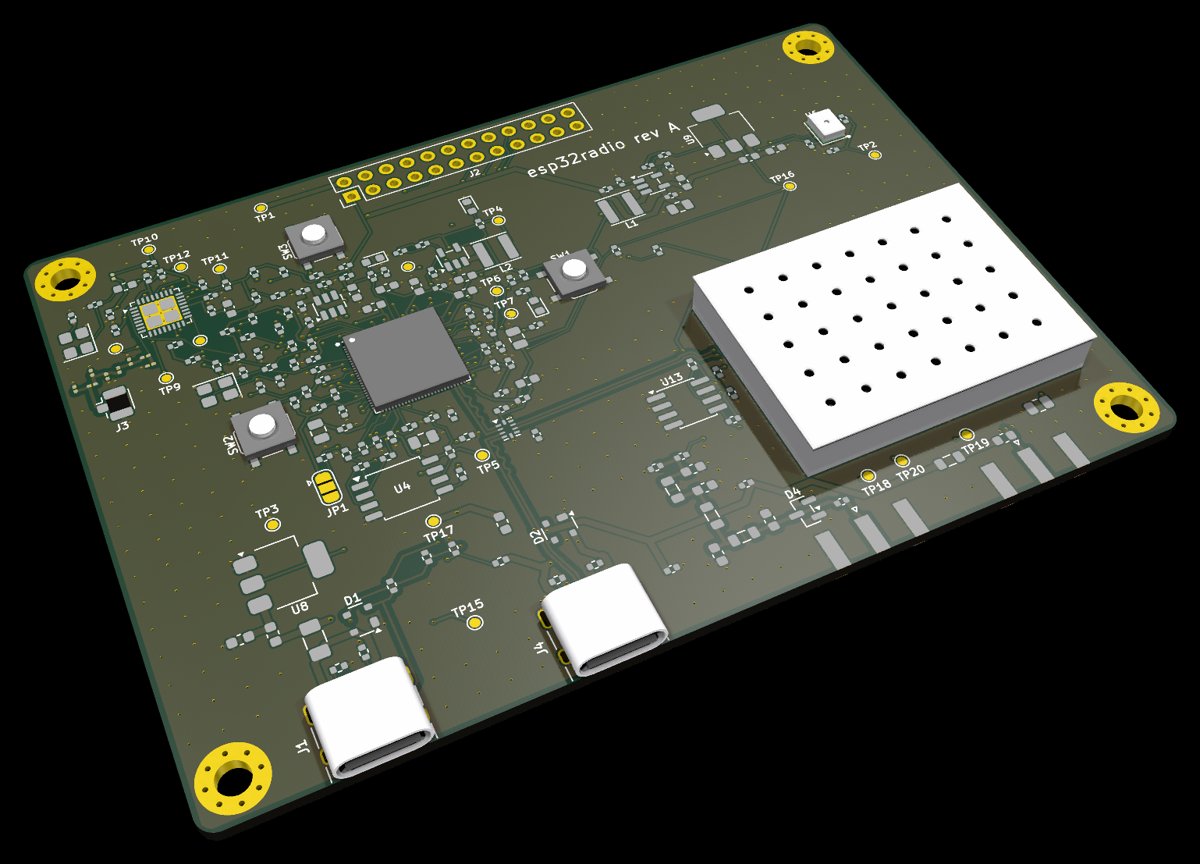
DESIGN RENDERING
RTL2832U + R860
Receiver chain with a 28.8 MHz TCXO
HF input
Second SMA, direct sampling, flat to 26 MHz
Wi-Fi 6 + BLE
ESP32-C6 over SDIO, external 2.4 GHz antenna
32 MB PSRAM
ESP32-P4 host with 16 MB flash
100 × 70 mm
Four-layer board, USB-C powered
20 GPIO
On a 2 × 12 expansion header
RF front end
- SMA input with switchable bias tee, 192 mA limit
- HF path through a 7th-order low-pass: −58 dB at 50 MHz, simulated
- ESD protection on both inputs; RF section in a shield
Host and streaming
- ESP32-P4 hosts the SDR over on-board USB 2.0 HS
- Serves rtl_tcp and a web UI over Wi-Fi
- Headless: no display or audio output
PC mode
- TS3USB221A switch moves the SDR to its own USB-C port
- Works with rtl_test and SDR++ with the P4 out of the loop
Sensing and expansion
- I²S MEMS microphone
- 2 × 12 header with I²C pair and ADC channels
- Three LEDs; RESET, BOOT and USER buttons
Power
- USB-C sink with ESD protection and a 2 A PTC
- Dedicated regulators for the tuner and demodulator
- About 1.16 A at 5 V peak estimate; needs a USB-C source advertising 1.5 A
Build
- Impedance-controlled RF, matched USB HS pairs
- Four-layer board
Need a networked SDR receiver?
Request a quote and tell us your band, range and quantity.
Request a Quote TodayFigures are design values or estimates, not measurements. Available for US Government use and as evaluation kits for product developers, software developers and system integrators. Export may be restricted under US export control regulations.